
Altitude Sickness

Updated: Jun 10, 2024
Altitude sickness is a disorder caused by being at high altitude (2500m+), where oxygen levels are low, without gradually getting used to the increase in altitude – Medical News Today.
Treatment:
Elevate at a (very) slow pace
Rest often
Take medication
Drink lots of water
Eat carbs
and in South America… Coca leaves!
Initially was going to travel all of South America by land but due to unforeseen circumstances (my best friend got engaged) I had to cut my trip short.
This meant that I had to fly to some places that would’ve taken too long to get to had I travelled by road. Also, in my research, travelling by road to mountainous areas is commonly suggested to ease your body into the high altitude (Elevate at slow pace).
Some symptoms include: Shortness of breath, Dizziness, Nausea, Vomiting, Headaches and Fatigue. Much like pregnancy symptoms – so, it can be very confusing.
Wait. Let’s take a brief look at the psyche… I generally struggle admitting to being sick. If I had the flu I’d call it a cough or a runny nose, I have never taken a sick day from work – the most I’d taken off would be an afternoon by leaving early and then continue to work from home because of my never-admit-defeat-complex. Heck, I don’t even like people knowing that I sleep – call me in the middle of the night and I’ll answer the phone like I’ve been doing push ups (why am I like this?) but Altitude Sickness I could not deny
Listen, I’m a coastal chick, I’ve spent my whole life living in coastal towns and most of my days I am no more than 10m (32 ft) above sea level.
Altitude Sickness generally starts at 2500m and I knew that I was headed to high-lying areas so as suggested, I had started taking the medication 48 hours prior to landing.
[Side confusing note: the Medication is highly suggested but it has some of the same side effects of Altitude Sickness plus some more so I don’t know why - consult a medical professional if you need more answers]

So, I’d left Rio de Janeiro (coastal town) and was on a flight, sandwiched between two grown men, headed for La Paz, Bolivia (3 640 meters high. AKA The city in the clouds) Great.
The man on my left by the window was chatty and we spoke in both English and Spanish, the one on the right was unconscious the entire way. I sipped water and kept my cup in the seat pouch in front of me. I started feeling intense pins and needles in my hands and feet, this was a side effect of the meds. As we descended Righty decide to come alive just as I started feeling light-headed and nauseas so I grabbed my cup and within a second I was offloading! But remember I don’t like being sick in front of people, so even though I was spasmodically spewing my guts out I still tried my best to keep it classy. When Leftie caught on he very politely gave me a puke bag from the pouch. I didn’t have time to feel mortified. I was thankful and I had to keep myself together. As I exited the plane I grabbed several puke bags from the seats I passed, I had a feeling - this was only the beginning…
Even with the medication I still felt most of the symptoms, and because of the light-headedness I felt the need to be as low as possible so I was crouching and crawling my way through the long immigration queues. I can’t stress enough how much I did not care what people thought.
Also, this airport had no Wi-Fi but luckily I screen shot my bookings and itineraries beforehand because, well, this aint my first rodeo, but they had some unnecessary procedures. I had to print documents out at one kiosk, pay for my visa at the other end of the airport then go back and get officially stamped in and, how amazing, during all this another side effect of my meds started kicking in… blurred vision. Best believe I was also using my puke bags in between!
Imagine all this admin plus immigration plus altitude sickness plus medication side effects at 03:30 in the morning - it was not fabulous.
Eventually I arrived at my accommodation, drank some coca tea and went straight to bed.
I have no idea if I slept for hours or days.

Thank heavens I was staying at a backpackers, and when I woke up I met my roommate, Justine, who I refer to as my Australian guardian angel. She understood my situation because she had been in this position a few weeks prior and was now nearing the end of her trip. And in between her exploring would bring me coca tea. Until one night, she decided she needed to get turnt and went out for a night on the town but mixed that with the iconic cobblestone roads of La Paz and fractured her ankle. Resulting in us both being man-down.
[The blessing in disguise: Justine had just done the Inca trail and I was headed that way but now we had time to exchange and I got first-hand advice and insights that I would have never found on the internet.]

Once I acclimated and the ‘acute’ symptoms subsided I felt more myself and could go exploring but I still had a slight light-headed sensation - remember the first time you tried hookah? Like that.
At sea level I’m pretty fit, like running up a flight of stairs has zero effect on my body. BUT HERE, 10 steps and I needed a break. It was like carrying an extra 25kg weight every time I walked uphill or upstairs. And to make matters more challenging, La Paz is a hilly city so just exploring by foot for an hour feels equivalent to a week of gym sessions.
I must admit, the first few days I took taxi’s uphill when the incline looked a bit much. Even though it was an embarrassingly short distance. Hey don’t judge me until it happens to you!
The tricky part is that once your body gets acclimatised you still feel symptoms every time you ascend and I ascended several times (Don’t ask me why – I was still learning self-love at this point)

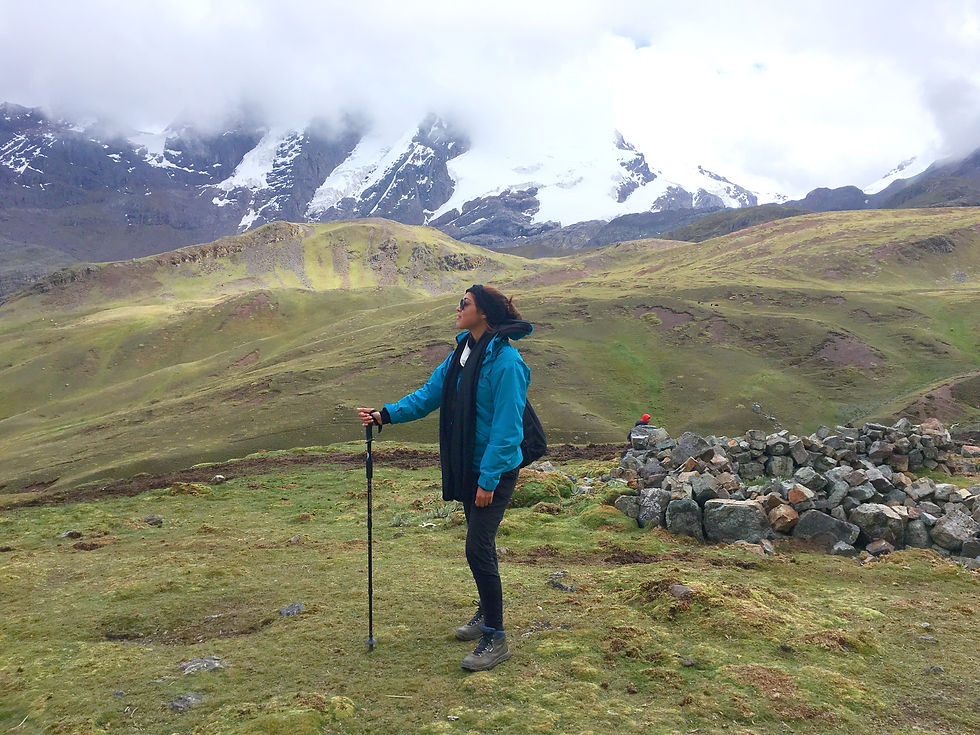
A representation of some of the drastic ascensions I conquered but the hardest one of all was Vinicunca (Rainbow Mountain / Montaña de Colores) in Peru.
[Side note: Rainbow Mountain was always covered by snow until just a few years ago when global warming melted the ice caps and revealed its beautiful, mineralogical layers, it was fresh on my bucket list and I was in the area so I had to drop by]
I was dead set on taking a horse instead of trekking after all I had just done the Inca trail and had been trekking for a few days and this was going to be the most challenging one. But at the last minute I decided not to because:
1. the horses take you on the ‘easy’ part of the trek and stop before the unbearable incline to the summit
2. peer pressure – no one else in my tour group was opting for it.
Most of the trek was ‘manageable’ but manageable at 4200m with symptoms of Altitude Sickness AND focusing on my breathing while trying to conquer the terrain AND chewing coca leaves while convincing myself that I'm feeling a slight buzz. The views were amazing but there were moments that I had to be in soldier mode and couldn’t really take it all in on the way there but got my chance to savour it on the way back.
HOWEVER the last stretch, woah, this was the greatest, most amazingly excruciating activity I have ever done. Seriously, this climb is so physically demanding, even if you are fit, the altitude really knocks you. I mean, you reach a height of 5200m (17 060 ft) that’s close to Everest base camp which sits at 5380m high.
So, I took few steps at a time and rested for a while with a canister of oxygen ready in hand incase I couldn’t anymore.
It was slow, it was strenuous and I felt like I was going to die

I didn’t die, but I made it right to the top, and the views were Spectacular! Photographs don’t do justice to the scenery, the hues, the height, the accomplishment of conquering a trek that high and feeling like you are literally on top of the world.
I spent some time taking it all in before I could stand up and do my happy dance and of course take photographs… and just as I started to descend it began to snow!
*** Sighs. What. A. Feeling!
Even though I did my research and equipped myself well enough to prepare for the situation, I never knew how my body would respond to the altitude. Everybody is different and fitness level means nothing when there is less oxygen going to your muscles. As intense as this was, it felt worth it in the end. Would I do this again? Probably not. Do I believe that? Definitely not.


Comments